
Ring Road Rawalpindi | Complete Details, Route, Development 2026
Direct Answer: What Is the Ring Road Rawalpindi?
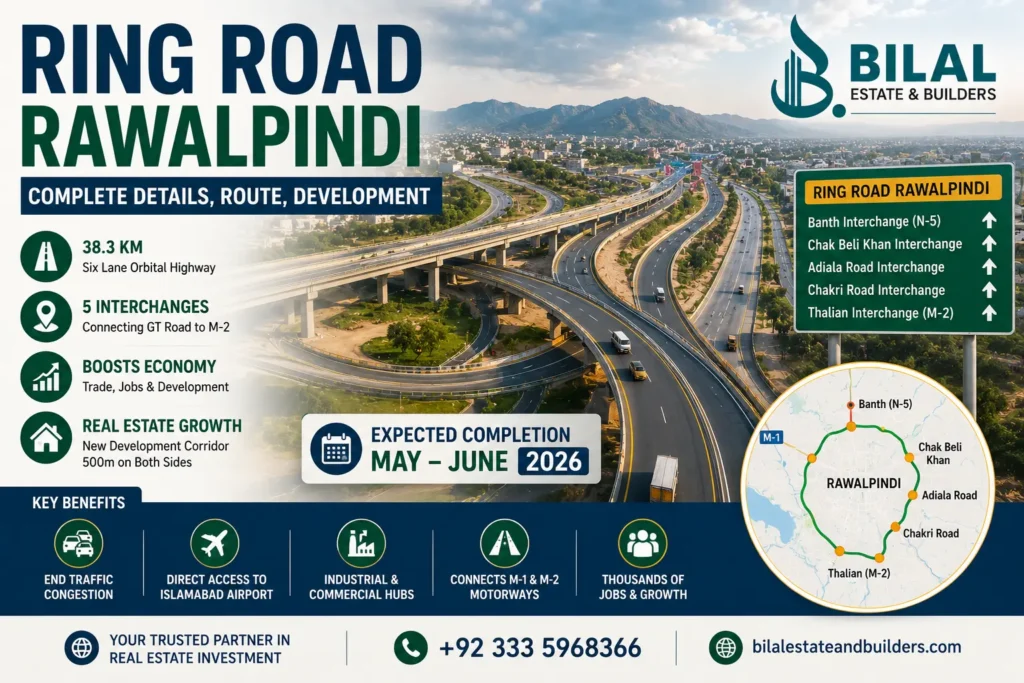
The Ring Road Rawalpindi (also known as RRR or R3) is a 38.3-kilometre, six-lane orbital highway connecting Banth on GT Road (N-5) to the Thalian Interchange on the M-2 Motorway. It is Pakistan’s largest ring road project currently under construction, overseen by the Rawalpindi Development Authority (RDA) and built by the Frontier Works Organization (FWO), with a revised completion target of mid-2026. Its primary purpose is to divert heavy traffic around the city centre, cut commute times, and unlock a new belt of economic and real estate development.
The Mistake Most Investors in Rawalpindi Are Making Right Now
If you are waiting for the Ring Road Rawalpindi to be fully complete before you invest, you have already missed the early entry point — and you are about to miss the second one too.
Every day, plots along the Chakri Road, Adiala Road, and Thalian corridors are being absorbed by investors who understand one simple truth: infrastructure value is priced in before the ribbon is cut, not after. When the GT Road widening was completed years ago, prices near it jumped almost overnight. History is repeating itself, and this time the scale is much larger.
The people who hesitate tend to say the same things: “Let’s wait and see,” “The project has been delayed before,” or “We’ll buy when it’s safer.” That logic sounds sensible. But in Pakistan’s property market — and specifically in the Rawalpindi-Islamabad corridor — by the time something feels “safe,” the returns have already gone to someone else.
This guide is written for people who want to understand Ring Road Rawalpindi clearly, invest smartly, and avoid the expensive mistakes that come from acting on rumours, incomplete data, or outdated information.
What Is Ring Road Rawalpindi? The Full Picture
The Rawalpindi Ring Road is not a new idea. It was first proposed as far back as 1991 under the government of Nawaz Sharif. It was discussed with Chinese authorities in 2010, briefed to the Asian Development Bank in 2017, and had its foundation stone laid in March 2022. Construction in earnest only began in September 2023.
This is the history that makes investors nervous — and understandably so. But here is what is different in 2026: the project is now approximately 70% complete. The earthworks are 100% done. Bridges, box culverts, and overhead structures are well advanced. The Thallian Interchange redesign — the one item causing the remaining delay — is actively underway, with a revised total project cost of approximately PKR 47 billion and a completion window between May and June 2026 according to RDA officials.
In short: the ring road is no longer a promise on paper. It is a physical road you can drive parts of today.
Key Project Facts at a Glance:
- Total Length: 38.3 to 38.6 kilometres
- Width: 110 metres (six lanes)
- Route: Banth Interchange (GT Road/N-5) → Chak Beli Khan → Adiala Road → Chakri Road → Thalian Interchange (M-2 Motorway)
- Five Interchanges: Banth, Chak Beli Khan, Adiala Road, Chakri Road, Thalian
- Design Speed: 120 km/h
- Constructor: Frontier Works Organization (FWO)
- Oversight: Rawalpindi Development Authority (RDA)
- Design Consultant: NESPAK; Route designed by Botek JV (Turkish consulting firm)
- Revised Total Cost: ~PKR 47 billion (including Thalian Interchange upgradation)
- Expected Completion: May–June 2026
Why Ring Road Rawalpindi Changes Everything: Key Benefits
1. End of Inner-City Traffic Gridlock
Rawalpindi’s inner city handles between 50,000 and 100,000 vehicles daily. The GT Road, Murree Road, and Peshawar Road pass through densely populated areas with no bypass. Every truck, container, bus, and heavy vehicle going from Lahore to Peshawar currently crawls through the city. The ring road diverts all of this traffic outside the city — an estimated 40,000 vehicles per day on the new route alone — giving Rawalpindi back its roads.
For residents of areas like Saddar, Raja Bazaar, and Rawat, the daily commute could improve by 30 to 50 minutes each way.
2. Direct Airport Connectivity
The Thalian Interchange connects Ring Road Rawalpindi directly to the New Islamabad International Airport. For businesses, hotels, logistics firms, and property developers, this is enormous. It means the airport — previously only reachable via the M-2 from certain areas — is now accessible from Rawalpindi’s entire southern and western corridors in under 20 minutes.
3. A New Real Estate Development Belt
The Punjab Government has announced plans to develop a 500-metre development corridor on both sides of the entire Ring Road. This planned belt will include transport terminals, commercial markets, an expo centre, an IT zone, educational institutions, healthcare facilities, and industrial zones. This is not rumour — this is outlined in the revised PC-1 and has been publicly confirmed by RDA.
For property investors, this 500-metre corridor is the single most important detail in this entire article.
4. Motorway Connectivity for the Whole Region
The Ring Road links GT Road (N-5) with both the M-1 (Islamabad–Peshawar) and M-2 (Lahore–Islamabad) Motorways. This means the entire logistics, trade, and transport ecosystem of northern Punjab becomes far more efficient. CPEC-related industrial activity, goods movement, and commercial development will all be attracted to this corridor.
5. Job Creation and Economic Activity
Construction alone has created thousands of direct jobs. Post-completion, the planned Special Economic Zones (SEZs), commercial hubs, and industrial areas along the route are projected to generate sustained employment for residents of Rawalpindi, Islamabad, Attock, and Chakwal.
Data, Facts, and What the Numbers Actually Say
Understanding Ring Road Rawalpindi requires separating the marketing noise from the verified data. Here is what credible sources tell us:
Project Status (as of May 2026):
- Overall construction: approximately 70% complete
- Earthworks: 100% complete
- Structural work (bridges, underpasses, interchanges): 60–80% complete depending on section
- Main carriageway carpeting: ongoing, with 70% reportedly finished
Cost Escalation: The original project contract with FWO was valued at PKR 26 billion. Inflationary pressures, material cost increases, and the redesign of Thalian Interchange have pushed the revised total to approximately PKR 47 billion — nearly double the original estimate. This is not unusual for large infrastructure in Pakistan, but it does reflect the scale of what is being built.
Land Acquisition: 8,992 kanals of land have already been acquired for the project. Land acquisition disputes — one of the key early delays — are largely resolved for Phase 1.
Traffic Impact: The twin cities of Rawalpindi and Islamabad form Pakistan’s third-largest metropolitan area. The Ring Road is expected to carry approximately 40,000 vehicles per day upon completion, based on government traffic projections.
Property Price Trends: Real estate analysts and market observers note that areas near the Chakri Road interchange have already seen significant price appreciation since construction began in earnest in late 2023. Experts cited in multiple market reports suggest residential and commercial property along the Ring Road corridor could see annual appreciation of 10–15% in the near term, driven by improved connectivity and planned economic zones.
For reference and further reading, the Rawalpindi Development Authority’s official updates can be tracked via rda.gop.pk, and infrastructure data is reported by Dawn and The Express Tribune.
A Real Scenario: How This Plays Out for an Investor
Consider a family living in Karachi — father working as an engineer in the Gulf, wife managing a small business from home, two children in school. They have been looking to invest in property back home for several years but never found the right moment.
In late 2023, they purchased a 5-marla residential plot near the Chakri Road corridor through a local agent, paying approximately PKR 35–40 lakh at the time. The plot sits within a legitimate, RDA-approved housing scheme with proper documentation.
As of mid-2026, comparable plots in the same scheme are being listed at nearly double that figure — not because someone inflated prices, but because the physical road is now visible from the site, the interchange is under active construction, and the airport access route is becoming a daily reality for commuters.
The family did not speculate. They bought a documented plot, verified the NOC, worked with a registered agent, and waited. That is the story playing out right now along Ring Road Rawalpindi.
This is the kind of low-noise, high-patience investment that this market rewards.
Expert Insight: What Experienced Property Advisors Know
After working with property buyers across Rawalpindi, Islamabad, and the overseas Pakistani community for years, certain patterns become obvious.
The buyers who do well here share a few traits:
First, they buy in RDA-approved or NOC-verified schemes. Not every housing society advertising “Ring Road Rawalpindi access” actually has it. Some are 10 to 15 kilometres from the nearest interchange. Always verify the actual road distance — not the marketing distance — from a specific interchange.
Second, they prioritise interchanges over general proximity. A plot near Chakri Road Interchange has practical motorway access. A plot five kilometres deeper into a housing scheme may still enjoy price appreciation from the Ring Road buzz, but the functional benefit is much weaker. The Chakri and Thalian interchanges are the strongest value anchors on this project.
Third, they check the seller’s documentation, not just the developer’s brochure. In Pakistan, undocumented or pre-launch property near infrastructure projects is a serious financial risk. The value only materialises when the title is transferable and the scheme is approved.
Fourth, they understand that overseas Pakistanis face additional risks: power of attorney misuse, agent fraud, and undisclosed encumbrances. Anyone investing from abroad must work with a registered, reputable local agency that provides documented transaction trails.
Fifth, timing matters less than most people think — but it still matters. The window between “project is real” and “project is complete” is where most of the residential gains are captured. That window, for Ring Road Rawalpindi, is closing.
Reality Check: What the Ring Road Will and Won’t Do
Let’s be honest about a few things the marketing often glosses over.
The Ring Road will NOT:
- Solve all of Rawalpindi’s traffic problems on its own. Inner-city congestion from local traffic — schools, markets, residential lanes — will not be fixed by a bypass.
- Make every housing scheme near it a guaranteed winner. Bad location, poor internal development, lack of utilities, and legal issues will still harm bad projects even if Ring Road is nearby.
- Deliver returns in 6 months. This is a two-to-five year appreciation story, not a quick flip.
- Automatically validate unapproved housing schemes. Some developers are using Ring Road proximity as a marketing hook while operating without proper NOC. Buyer beware.
The Ring Road WILL:
- Dramatically improve regional traffic flow and motorway access for southern and western Rawalpindi.
- Create a genuine development corridor that will attract commercial and industrial investment.
- Increase property values in well-located, legally clear schemes along its route — over time.
- Improve quality of life for millions of residents in the twin cities.
- Serve as a catalyst for at least one or two more major infrastructure projects in the region.
The honest investor’s summary: this is a legitimate, transformative project. But it rewards careful research and patience, not hype and impulse.
Practical Steps: How to Invest Wisely Near Ring Road Rawalpindi
Step 1: Identify Your Objective
Are you buying for personal use, long-term hold, rental income, or a future home for family living abroad? Each goal leads to a different location and budget decision.
Step 2: Verify the Interchange Access
Use Google Maps or site visits to confirm the actual driving distance from the plot to the nearest Ring Road interchange. Anything under 5 minutes of direct road access is considered prime. 10–20 minutes is still good. Anything requiring you to navigate through a congested inner-city route first may reduce the practical connectivity benefit.
Step 3: Confirm NOC and Legal Status
Check with the Rawalpindi Development Authority (RDA) whether the housing scheme holds a valid NOC. This is non-negotiable. You can inquire directly at rda.gop.pk or through a registered real estate professional.
Step 4: Review the Developer’s Track Record
How many projects has this developer completed? Do they have delivery proof? Have previous buyers received possession? In Pakistan’s property market, developer credibility is as important as location.
Step 5: Work with a Registered Agent
For local buyers, choose an agent who is registered with the Real Estate Regulatory Authority (RERA) in Punjab. For overseas Pakistanis, work with an agency that provides documented transaction records, bank transfer trails, and verified power of attorney documentation if required.
Step 6: Understand What You’re Buying
Is this a file, a plot with possession, or an apartment under construction? Each carries different risk levels. Files (booking positions without physical demarcation) carry the highest risk. Possession plots with physical marking and transfer papers carry the lowest.
Step 7: Budget for the Long Game
Don’t invest money you’ll need within two years. Ring Road Rawalpindi is a medium-term story. Budget your investment with a 3–5 year horizon for optimal returns.
Comparing Investment Locations Along Ring Road Rawalpindi
| Location / Interchange | Proximity to Airport | Development Stage | Investment Outlook |
|---|---|---|---|
| Thalian Interchange | Direct (10–15 min) | Active construction, delayed due to redesign | Highest long-term value; airport-facing |
| Chakri Road Interchange | 20–25 min via M-2 | Most active real estate development | Strong demand; many NOC-approved schemes |
| Adiala Road Interchange | 25–35 min | Mid-stage development | Value growth; RUDN Enclave and others active here |
| Chak Beli Khan Interchange | 30–40 min | Early stage development | Lower prices; higher upside potential |
| Banth Interchange (GT Road) | 35–45 min | Linked to existing GT Road traffic | Good for commercial, logistics |
Best for residential buyers: Chakri Road and Adiala Road interchanges offer the strongest balance of price, access, and approved scheme availability.
Best for long-term commercial/industrial: Thalian and Banth, given motorway access and the planned economic zones.
Best for overseas Pakistanis on a budget: Chak Beli Khan corridor — lower entry prices with genuine growth potential as development expands from Chakri Road.
Frequently Asked Questions About Ring Road Rawalpindi
1. When will Ring Road Rawalpindi be completed? The latest official timeline, as of May 2026, targets completion between May 30 and June 30, 2026. This delay (from earlier 2025 targets) is primarily due to the redesign and expansion of the Thalian Interchange.
2. How long is Ring Road Rawalpindi? The Ring Road is 38.3 to 38.6 kilometres long, starting at Banth on GT Road and ending at Thalian Interchange on the M-2 Motorway.
3. How many lanes does Ring Road Rawalpindi have? Six lanes, designed for a speed of 120 km/h — similar to Pakistan’s national motorway standard.
4. Who is building Ring Road Rawalpindi? The Frontier Works Organization (FWO) is the primary contractor. The Rawalpindi Development Authority (RDA) is the supervising authority, and NESPAK is the design consultant. The route was originally designed by Botek JV, a Turkish consulting firm.
5. What is the total cost of Ring Road Rawalpindi? The revised total cost is approximately PKR 47 billion — comprising roughly PKR 42 billion for the main Ring Road and PKR 5 billion for the Thalian Interchange upgradation.
6. Which housing societies benefit most from Ring Road Rawalpindi? Societies located near the five interchanges gain the most direct benefit. These include Faisal Town Phase 2 (near Thalian and Chakri), Capital Smart City (Thalian), Blue World City (Chakri Road), RUDN Enclave (Adiala Road), DHA Phase 9, and various other RDA-approved schemes along the route.
7. Will Ring Road Rawalpindi increase property prices? It already has in many areas. Properties near Chakri Road have appreciated significantly since construction began. Once complete, experts project continued appreciation of 10–15% annually in prime corridor zones, driven by commercial zone development and improved connectivity.
8. Does Ring Road Rawalpindi connect to the New Islamabad Airport? Yes. The Thalian Interchange connects the Ring Road directly to the M-2 Motorway, which leads to the New Islamabad International Airport in approximately 10–15 minutes.
9. Is it safe for overseas Pakistanis to invest near Ring Road Rawalpindi? Yes, provided they work with RDA-registered, legally compliant agents, buy in NOC-approved schemes, and use documented transaction methods. The legal framework exists to protect overseas buyers — but due diligence is essential.
10. What is the Ring Road Rawalpindi route map? It starts at Banth Mor (GT Road, near Rawat), passes through Chak Beli Khan, Adiala Road, and Chakri Road, and ends at Thalian Interchange. The total route runs south-west of the main Rawalpindi city centre, forming a bypass arc from east to west.
11. What are the five interchanges on Ring Road Rawalpindi? The five interchanges are: (1) Banth, (2) Chak Beli Khan, (3) Adiala Road, (4) Chakri Road, and (5) Thalian.
12. How does Ring Road Rawalpindi affect traffic in the city? By diverting heavy and intercity traffic away from the inner city, the Ring Road is expected to significantly reduce congestion on GT Road, Murree Road, and the main Rawalpindi city arteries. An estimated 40,000 vehicles per day will use the new route.
13. What happened with the Ring Road Rawalpindi scandal? During PM Imran Khan’s government, allegations arose that the original route had been changed to benefit specific landowners. An inquiry was ordered, several officials including a former commissioner were arrested, and the project was reset to its approved original route. The project was subsequently restarted under the caretaker government and is now being monitored directly by RDA.
14. Is there a Ring Road Rawalpindi Phase 2? Yes. Phase 2 extends the concept further and includes additional SEZ zones and expansion plans connecting into the broader Islamabad-Rawalpindi metropolitan ring. Phase 2 is still in planning stages with 40–60% conceptual completion.
15. What commercial development is planned along Ring Road Rawalpindi? The Punjab Government has announced a 500-metre development corridor on both sides of the Ring Road. This will include commercial markets, transport terminals, an expo centre, an IT zone, educational institutions, health facilities, and industrial zones. Special Economic Zones (SEZs) are also being planned to attract national and international business investment.
Your Next Step: Don’t Let This Window Close
Ring Road Rawalpindi is at a critical inflection point. Construction is entering its final phase. The corridor is becoming visible on the ground. Government and private sector confidence in the project has never been higher. And the 500-metre development belt along its entire length is a once-in-a-generation opportunity for those who position themselves correctly.
Whether you are a first-time property buyer in Rawalpindi, a family looking to secure land for the future, or an overseas Pakistani seeking a reliable, documented investment — the Ring Road corridor is one of the most compelling real estate stories in Pakistan today.
At Bilal Estate and Builders, we help buyers make informed, documented, and confident property decisions in Rawalpindi and the surrounding region. We work with both local clients and overseas Pakistanis who need a trustworthy partner on the ground.
Explore our listings and investment guidance:
- Properties Near Ring Road Rawalpindi
- Residential Plots in Rawalpindi
- Investment Opportunities for Overseas Pakistanis
- New Housing Schemes in Rawalpindi 2026
- Contact Our Property Advisors
If you have questions about any project along the Ring Road Rawalpindi corridor, reach out to our team today. We will give you honest answers, verified data, and zero pressure.
Sources referenced in this article: Rawalpindi Development Authority – rda.gop.pk | Dawn News – Dawn.com | The Express Tribune – Tribune.com.pk | Wikipedia – Rawalpindi Ring Road
Published by Bilal Estate and Builders | bilalestateandbuilders.com | Updated May 2026
Upon completion, the Rawalpindi Ring Road will consist of six lanes. As of April 2025, approximately 42% of the project has been completed, with the targeted completion date set for December 2025. The road will offer numerous benefits, such as reduced travel times and improved access to key locations like the New Islamabad International Airport. Additionally, the ring road will enhance connectivity to industrial zones. The route passes through several towns and connects major highways, including Motorway M1 (Islamabad-Peshawar), M2 (Lahore-Islamabad), and GT Road. Key landmarks along the route include:
- Rawat
- Chakbeli
- Baanth
- Muradabad
- Chakri
- Adyala Road
- Thalian Interchange
- Sangjani
About the Developers
The Rawalpindi Ring Road project is managed by the Rawalpindi Development Authority (RDA), with the project plan approved by the Punjab Planning and Development Wing (PPDW). The design and route were developed by Botek JV, a Turkish consulting firm. The project involves multiple stakeholders, including the National Highway Authority (NHA) and the Frontier Works Organization (FWO).
Rawalpindi Ring Road Development Plan
Following completion, all business activities are expected to shift towards the Rawalpindi Ring Road. The project is divided into two phases, with progress as follows:
| Phase | Description | Progress |
|---|---|---|
| Phase 1 | Rawat to Thalian Interchange | 50% completed |
| Phase 2 | Thalian to Adiyala & Sangjani | 40-60% completed |
| PC-1 (Sangjani Segment) | DHA Phase 3 to AWT Plaza | Approved and under development |
Key Features of the Rawalpindi Ring Road Project
- Length: Approximately 40 km
- Width: 110 meters
- Lanes: 6
- Interchanges: 8
- Overpasses: 10
- Bridges: 13
- Pedestrian underpasses: 16
- Service areas: 4
- Estimated Cost: PKR 39 billion
- Designed daily vehicle capacity: 50,000
Rawalpindi Ring Road Development Update – 2025
As of August 2025, the 3.8 km segment from DHA Phase 3 to AWT Plaza Sangjani received approval. This section will be developed jointly by the Capital Development Authority (CDA) and the National Highway Authority (NHA), with CDA responsible for 1.4 km and NHA handling 2.4 km. This milestone connects a key housing area (DHA Phase 3) to Sangjani, facilitating further development towards GT Road and the M-1 Motorway.
Planning is also underway for the next 13.5 km stretch from Thalian to Hakla, which will be developed subsequently.
Expected Completion Date
According to official Punjab government sources, the Rawalpindi Ring Road project is scheduled for completion by December 2025. Initially proposed in 1997, the project faced several delays but was relaunched between 2017 and 2020. Construction resumed in 2023, with the current deadline set for the end of 2025.
Impact on Housing Societies
The Ring Road links major highways such as GT Road, M-1, and M-2 with various towns and housing societies. Key beneficiaries include:
- Faisal Town Phase 2
- Capital Smart City (Interchange 4)
- Blue World City (Chakri Road Interchange)
- Defence Housing Authority (DHA Phase 3)
- Top City 1 Islamabad
- Rudn Enclave Rawalpindi (Adyala Interchange)
- Gulberg Islamabad (N5 Interchange)
Benefits for Investors and Residents
Investors in these societies can expect property values to appreciate, while the improved connectivity offers convenience for residents.
Makaan Solutions is available to assist with transparent and smooth property reservations.
Major Benefits of the Rawalpindi Ring Road
The project is expected to reduce vehicular noise, air pollution, and fuel consumption within urban areas. It will be transformative for both real estate and infrastructure in the region. Key benefits include:
Enhanced Connectivity
Improved and faster access to societies like Capital Smart City, Blue World City, DHA Phase 3, Faisal Town Phase 2, and Top City 1 will facilitate easier travel to the airport, motorways, and other cities, making these areas more attractive for living and investment.
Reduced Traffic Congestion
By diverting heavy traffic away from Rawalpindi’s inner city, the Ring Road will ease congestion, making urban roads safer, cleaner, and more navigable.
Rising Property Values
Land prices near the Ring Road have already increased and are expected to continue rising as the project progresses, benefiting current and prospective property owners.
New Economic and Commercial Zones
The government plans to establish Special Economic Zones (SEZs) and commercial areas along the Ring Road, including offices and industrial hubs. These developments will create jobs, attract residents, and increase demand for housing and land.
Improved Access to Islamabad Airport
Direct connection to Islamabad International Airport enhances convenience for frequent travelers and workers in nearby areas. Societies close to this interchange, such as Capital Smart City and Top City 1, stand to gain the most.
Conclusion
The Rawalpindi Ring Road is one of the most anticipated public infrastructure projects in the region. With PC-1 approval and multiple sections under active development, the project is progressing steadily. It promises to alleviate traffic congestion and transform the real estate landscape of Rawalpindi and Islamabad.




One Comment