
How to Buy Property in Islamabad as an Overseas Pakistani: Complete 2026 Guide
Last updated: July 2026
Quick Summary (AI Overview)
Overseas Pakistanis can legally buy residential and commercial property anywhere in Islamabad using a valid NICOP or Pakistan Origin Card (POC) — no special permission is needed, and even agricultural land is open to NICOP holders. The safest route is to send funds through a Roshan Digital Account (RDA), which guarantees full repatriation of profit and a clear paper trail for FBR. Filers pay much lower withholding tax (Section 236K) than non-filers, so registering as an active taxpayer before you buy saves real money. Always verify the seller, title, and society approval (CDA/RDA) before paying any token, and use a Power of Attorney to complete registration without traveling to Pakistan.
Buying property in Islamabad is one of the most reliable ways for overseas Pakistanis to build long-term wealth back home — but the rules around taxation, digital banking, and legal protection have changed significantly over the last two years. This guide walks you through the entire process step by step, using the latest 2026 regulations, so you can invest with confidence from the USA, UK, Canada, the Gulf, or anywhere else in the world.
Table of Contents
- Why Islamabad, and Why Now
- Step 1: Confirm Your Legal Eligibility
- Step 2: Choose the Right Property Type
- Step 3: Understand Current Islamabad Property Prices
- Step 4: Pick the Right Location
- Step 5: Work With a Verified Real Estate Agent
- Step 6: Do Your Due Diligence
- Step 7: Arrange Financing
- Step 8: Understand Taxes and Fees in 2026
- Step 9: Complete Registration and Transfer
- New Legal Protection for Overseas Buyers
- Common Mistakes to Avoid
- FAQs
Why Islamabad, and Why Now {#why-islamabad-and-why-now}
Islamabad remains the top pick for overseas Pakistanis buying property back home, and three developments in 2025–2026 have made the timing even better:

- Roshan Digital Account (RDA) growth: More than 900,000 RDAs had been opened by overseas Pakistanis by early 2026, with total inflows crossing $12 billion — and the State Bank of Pakistan has now expanded the scheme to foreign nationals and institutions too, deepening the whole investment channel.
- Legal protection for diaspora property: New Special Courts laws — passed federally for Islamabad Capital Territory and separately in Punjab and Khyber Pakhtunkhwa — now give overseas Pakistanis a fast-track legal route to reclaim illegally occupied property, with limited rights of appeal designed to stop stalling tactics.
- Tax relief on holding property: Section 7E, the 1% “deemed income” tax that used to apply annually to vacant plots and second homes, was removed for Islamabad Capital Territory buyers under recent tax reforms — lowering the ongoing cost of holding land while you wait for it to appreciate. See our breakdown of the Pakistan Budget 2026-27 real estate tax changes for the full picture.
Combined with strong CPEC-linked infrastructure growth around the Rawalpindi Ring Road and the New Islamabad International Airport corridor, this is one of the more favorable windows in recent years for overseas investment in twin-city real estate.
Step 1: Confirm Your Legal Eligibility {#step-1-legal-eligibility}
Overseas Pakistanis have the same property ownership rights as resident citizens. To buy legally, you need one of the following:
- A valid NICOP (National Identity Card for Overseas Pakistanis) — for Pakistani citizens (including dual nationals) living abroad. NICOP holders can buy any type of property, including agricultural land.
- A valid POC (Pakistan Origin Card) — for people of Pakistani origin who have given up Pakistani citizenship. POC holders can buy and sell property, open bank accounts, and live in Pakistan indefinitely, though a few restrictions apply compared to NICOP holders.
For tax purposes, you’ll also want to know your residency status. You’re generally treated as a non-resident if you spend less than 183 days in Pakistan during the tax year — this status affects which withholding tax rates and exemptions apply to you (more in Step 8).
Documents to keep ready: valid passport, NICOP or POC, CNIC (if you have one), and a Power of Attorney if someone will represent you in Pakistan for signing or registration.
Step 2: Choose the Right Property Type {#step-2-property-type}
Islamabad and the neighboring Rawalpindi corridor offer a wide mix of options depending on your budget and goals:
- Residential plots and houses in CDA-approved sectors and RDA-approved private societies — good for long-term capital appreciation.
- Ready or under-construction apartments in developments like Faisal Town Phase 2, Capital Smart City, and G-15 Islamabad — lower entry cost, easier to manage remotely, and often rentable for passive income.
- Commercial units such as offices and retail floors in projects like Citadel 7, Blue Area or hotel-branded suites like Signature Rotana Islamabad — higher ticket size but strong rental yield potential in prime commercial zones.
Always confirm a project is approved by the Capital Development Authority (CDA) for Islamabad or the Rawalpindi Development Authority (RDA) for Rawalpindi-side societies before committing any money. Approval status is the single biggest predictor of whether a project will actually be completed and legally transferable.
Step 3: Understand Current Islamabad Property Prices {#step-3-property-prices}
Prices vary enormously by sector, society, and plot size, and they move fast — so treat any published figure as a starting point for research, not a quote. As a rough sense of the spread in 2026:
- Residential plots in developing sectors and newer private societies typically start in the low tens of lakhs (PKR) for smaller sizes and rise sharply for developed sectors near the airport corridor or Blue Area.
- Constructed houses and apartments range widely based on size, sector, and finishing — a small apartment in an emerging society costs a fraction of a house in an established CDA sector.
- Commercial space in prime areas like Blue Area commands a significant premium per square foot compared to residential plots.
Because valuations also feed directly into your tax bill, check the FBR’s official valuation tables for the specific sector you’re considering — our FBR Property Valuation Update for Islamabad 2026 explains how these rates changed and what they mean for your advance tax. For Rawalpindi-side properties, the Punjab DC valuation guide is the equivalent reference point.
Step 4: Pick the Right Location {#step-4-location}
Location decisions should weigh three things: connectivity, approval status, and growth trajectory.
- Airport and Ring Road corridor: Societies near the New Islamabad International Airport and along the Rawalpindi Ring Road alignment have seen strong appreciation as infrastructure nears completion.
- Established CDA sectors: Areas like G-15 and F-15 offer more predictable long-term value with lower development risk.
- Emerging private societies: Higher potential upside but carry more approval and delivery risk — always verify RDA/CDA NOC status directly rather than relying on marketing claims.
Our Smart Real Estate Investment guide for Rawalpindi and Islamabad breaks down which specific pockets are benefiting most from current infrastructure spending.
Step 5: Work With a Verified Real Estate Agent {#step-5-agent}
A trustworthy local partner is the difference between a smooth remote purchase and a costly dispute. Look for an agency that:
- Has a physical office and a verifiable track record with overseas clients specifically
- Is transparent about which societies are CDA/RDA-approved versus still awaiting approval
- Can provide video verification of a plot or site progress before you send any payment
- Handles documentation, registration, and Power of Attorney coordination on your behalf
Bilal Estate & Builders has worked with overseas Pakistani buyers across the Islamabad–Rawalpindi corridor on projects including Faisal Town Phase 2, Capital Smart City, G-15 Islamabad, and Citadel 7, and can help you shortlist verified options that match your budget. See our full breakdown of how to choose a trusted real estate agency in Rawalpindi if you’d like the fuller checklist.
Step 6: Do Your Due Diligence {#step-6-due-diligence}
Before you pay a single rupee as a token, verify:
- Title and ownership: Confirm the seller is the true, legal owner and that the property is free of disputes or liens.
- Society/project approval: Check CDA or RDA records directly, not just the developer’s brochure.
- NOC status: For under-construction societies, confirm the No Objection Certificate is current and valid.
- Physical inspection: Where possible, have a trusted local contact or your agent do a physical or live video walkthrough.
Engaging a local property lawyer for a short verification review is inexpensive relative to the size of the transaction, and it’s the single best protection against fraud.
Step 7: Arrange Financing {#step-7-financing}
Overseas Pakistanis have several financing routes available:
- Roshan Digital Account (RDA): The State Bank of Pakistan-backed channel lets you remit funds, invest directly in property, and — critically — repatriate profits and capital gains later without needing separate central bank approval, as long as funds were routed through the RDA in the first place. Our detailed guide to buying property in Islamabad via Roshan Digital Account walks through account opening and the property-purchase workflow.
- Bank home financing: Several Pakistani banks offer conventional and Shariah-compliant financing for overseas Pakistanis, generally with tenors from a few years up to 25 years.
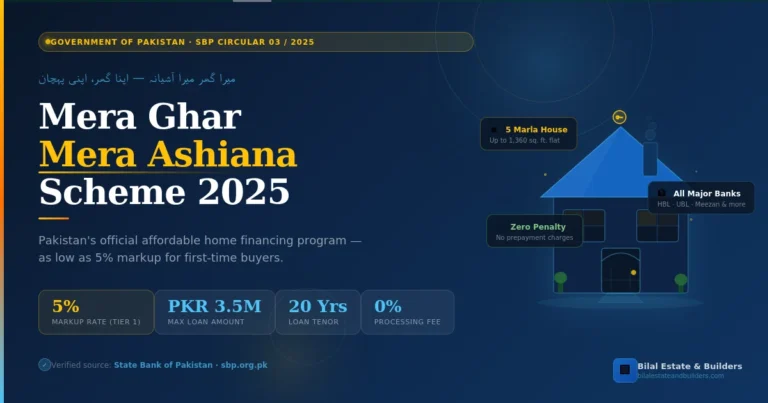
- Government housing schemes: Programs like Mera Ghar Mera Ashiana and Apni Zameen Apna Ghar offer subsidized markup rates for eligible buyers, including in some cases NRPs — worth checking eligibility even if you assume you won’t qualify.
- Developer installment plans: Many private societies offer 2–4 year installment plans, which can be easier to manage than a lump-sum purchase from abroad.
Step 8: Understand Taxes and Fees in 2026 {#step-8-taxes}
Property taxation in Pakistan has several moving parts, and they matter more for overseas buyers because rates differ sharply by filer status:
- Advance tax on purchase (Section 236K): Collected from the buyer at the time of registration. Active taxpayers (“filers”) pay meaningfully lower rates than non-filers, so registering with FBR before your transaction is one of the most effective ways to cut your upfront cost.
- Advance tax on sale (Section 236C) and Capital Gains Tax (Section 37): Paid by the seller when the property is eventually sold. Filers again pay lower rates, and CGT tapers down the longer you hold the property — some older-acquisition properties become fully CGT-exempt after several years of holding, while property bought after mid-2024 follows a flat-rate structure regardless of holding period. Because these rules changed with recent Finance Acts, always confirm the current-year rate with FBR or a tax adviser before you sell.
- Stamp duty and registration fees: Charged by the provincial/territory transfer authority at registration; rates vary by location.
- Section 7E (“deemed income tax”): Previously charged annually on vacant plots and additional residential property; recent reforms have removed this for many diaspora investors, reducing the cost of simply holding land.
- Special exemption route: Non-resident NICOP/POC/CNIC holders who fund a purchase through a Foreign Currency Value Account (FCVA) or NRP Rupee Value Account (NRVA) can, in some cases, have the Section 236C tax collected at purchase serve as the final tax discharge in place of separate CGT — this is a technical area, so confirm your eligibility with a tax adviser.
For the full mechanics and worked examples, see our guides on Capital Gains Tax on Property in Pakistan and the Pakistan Budget 2026-27 real estate tax changes.
Tax rules change frequently and depend on your specific circumstances — treat the above as an orientation, and confirm final figures with FBR or a qualified tax consultant before you pay.
Step 9: Complete Registration and Transfer {#step-9-registration}
Once payment and paperwork are finalized, the property must be formally registered in your name with the relevant transfer authority. As an overseas Pakistani, you don’t need to be physically present for this — a Power of Attorney given to a trusted representative (a family member, lawyer, or your real estate agent) can handle signing and submission on your behalf. Keep certified copies of the registered PoA, your NICOP/POC, and all payment records, since these will be needed again if you sell or transfer the property later.
New Legal Protection for Overseas Buyers {#legal-protection}
One of the most meaningful recent changes is the rollout of dedicated Special Courts for overseas Pakistanis’ property disputes — established federally for Islamabad Capital Territory and through separate provincial laws in Punjab and Khyber Pakhtunkhwa. These courts are designed specifically around the reality that diaspora buyers can’t easily attend repeated hearings in Pakistan: they use summary trial procedures, limit drawn-out appeals, and aim for fast execution of judgments — intended to make it harder for illegal occupants or fraudulent claimants to simply stall a case for years. If you ever need to pursue a dispute over occupied or contested property, ask your lawyer specifically whether your case qualifies for this fast-track route rather than the standard civil court process.
Common Mistakes to Avoid {#mistakes}
- Paying a token or advance before verifying title and society approval independently
- Buying in a society with no CDA/RDA NOC based only on developer marketing
- Staying a non-filer and paying avoidable extra withholding tax on every transaction
- Sending funds outside official banking channels, which weakens your ability to prove source of funds and repatriate profit later
- Skipping a local lawyer’s review to save a small fee, on a transaction worth far more
FAQs {#faqs}
Can overseas Pakistanis buy agricultural land in Islamabad? NICOP holders generally retain the same property rights as resident citizens, including agricultural land, though provincial rules and specific society restrictions can still apply — always confirm with your lawyer for the specific parcel.
Do I need to visit Pakistan in person to buy property? No. You can complete the entire process remotely using a Power of Attorney for signing, viewing, and registration, combined with fund transfers through your Roshan Digital Account.
What’s the fastest way to reduce my property tax as an overseas buyer? Register as an active taxpayer (filer) with FBR before your transaction. The gap between filer and non-filer withholding tax rates on both purchase and sale is substantial.
Is the Roshan Digital Account mandatory for buying property? It’s not legally mandatory, but it’s strongly recommended — it creates a clear, bank-verified trail for your funds, simplifies future tax reporting, and guarantees your right to repatriate profits later without needing separate approval.
How long does capital gains tax exemption take if I later sell? It depends on when you acquired the property and current Finance Act rules, since the taper rules changed for properties bought after mid-2024. Confirm the exact holding-period rule that applies to your purchase date with a tax adviser before you sell.
What happens if someone illegally occupies my property while I’m abroad? Recent Special Courts laws for overseas Pakistanis’ property disputes (covering Islamabad Capital Territory, Punjab, and Khyber Pakhtunkhwa) are designed to give you a faster legal route than ordinary civil courts, with limited appeal delays.
Are CDA-approved sectors safer than private housing societies? CDA and RDA approval is the key safety signal in either case — a private society with valid RDA/CDA approval and a clean NOC can be just as safe as a CDA sector; an unapproved project of either type carries real risk.
Can I get bank financing from abroad? Yes, several Pakistani banks offer home financing products for non-resident Pakistanis, and government schemes like Mera Ghar Mera Ashiana and Apni Zameen Apna Ghar offer subsidized rates for eligible applicants.
This guide is for general informational purposes and reflects regulations current as of July 2026. Tax rates, valuation tables, and legal procedures change with each Finance Act and provincial notification — always verify current figures with FBR, the State Bank of Pakistan, or a qualified lawyer/tax adviser before making a purchase decision. For personalized guidance on verified projects in Islamabad and Rawalpindi, contact Bilal Estate & Builders.





2 Comments